No Dead Artists Press Release

Beki Borman Featured in National No Dead Artist Exhibition

Press Release:

August 27, 2010

The 14th Annual No Dead Artists National Juried Exhibition of Contemporary Art
Juried by Beth Rudin DeWoody, Donna Perret Rosen and Fairfax Dorn

For Immediate Release

August 27, 2010 (New Orleans, LA)

The Jonathan Ferrara Gallery is pleased to announce the jury winners for the 14th Annual NO DEAD ARTISTS National Juried Exhibition of Contemporary Art. This edition marks the first time this long-running juried exhibition will feature artists from across the entire US.

The exhibition opens on Saturday September 4, 2010 with an artists’ reception from 6 – 9pm. Each year the show draws thousands of art enthusiasts and focuses attention on an emerging generation of contemporary artists that are poised to breakthrough into the greater art world.

The No Dead Artists juried exhibition was founded in 1995 to give a voice to emerging artists. The exhibition’s name is derived from the old adage that artists never achieve any success until they die. No Dead Artists turns that on its head and gives emerging artists their first break into the art world. In the 90’s, the exhibition was open only to New Orleans artists and then it grew to include artists of Louisiana. Now in its 14th edition, the exhibition has expanded to become a national juried exhibition open to artists from the entire US.

The exhibition has been a springboard for several artists leading to national press coverage, national recognition, gallery representation and acquisitions by museums and other prominent collections. Each year gallery owner Jonathan Ferrara invites a panel of renowned arts professional and collectors to select the newest creative talents. The exhibition opening draws thousands of art enthusiasts to the gallery to see this new generation of emerging talent.

The 2010 No Dead Artists prestigious jurors were:

Beth Rudin DeWoody is regarded as one of the top contemporary collectors in the US as well as a curator of exhibitions. She is on the board of the Whitney Museum of American Art, Creative Time, Find Your Voice, Inc., New School University, Brooklyn Academy of Music (BAM) and is on the Photography Steering Committee at the Norton Museum.

Fairfax Dorn is the Co-founder and Executive Director of the non-profit cultural space, Ballroom Marfa located in Marfa, TX. Ballroom Marfa and a member of the board of The Whitney Museum of American Art, New York, NY; Judd Foundation, New York and Marfa; Exit Art, New York; Centre Pompidou Foundation, Los Angeles and Paris.

Donna Perret Rosen was Director/Owner of Galerie Simone Stern in New Orleans for 23 years. She is a trustee of The Whitney Museum of American Art and a National Trustee of New Orleans Museum of Art.

This year over 350 artists submitted over 1900 works of art to the No Dead Artists jury. Twenty artists were selected to have their work exhibited at Jonathan Ferrara Gallery. The 2010 exhibition features painting, sculpture, mixed media, photography and video works. In addition to having their works exhibited at Jonathan Ferrara Gallery, selected jury winners will be featured in an article on ArtDaily.org, The First Art Newspaper on the Net, written by art critic, D. Eric Bookhardt (ArtPapers and Gambit Weekly). ArtDaily has @600,000 visitors per month and the Art Daily Newsletter reaches over 16,000 readers daily.

The 2010 No Dead Artists jury winners are:

Meghan Boody, New York, NY
Beki Borman, Milwaukee, WI
Charisse Celino, New Orleans, LA
Hanna Chalew , New Orleans, LA
Diana Doherty , New York, NY
Siobhan Feehan, New Orleans, LA
Rieko Fujinami , Beacon , NY
Heather Gordon, Durham, NC
Julia Haw, Chicago, IL
Becky Joye, Austin, TX
Barbie L’Hoste , New Orleans, LA
Jason Lewis, Enid, OK
Jon McIntosh, Key West, FL
David Rae Morris, New Orleans, LA
Grant Newman, Chicago, IL
Randy Polumbo, New York, NY
Aaron Reichert , New Orleans, LA
Monica Rezman, Chicago, IL / India
Ashley Robins, New Orleans, LA
The Serie Project, Austin, TX

The breadth of the artists chosen by this year’s jury ranges from graduate students pursuing their MFA’s to artists whose work has been exhibited nationally and internationally.

From the ethereal drawings on clear film by Japanese artist Reiko Fujinami to the elaborately staged photographs by New York artist Meghan Boody to the detailed serigraphs of The Serie Project from Austin,TX, the No Dead Artists exhibition, yet again, unearths fresh new talent and brings these new creative voices to a wider art audience.

The 14th Annual No Dead Artists Juried Exhibition of Contemporary Art opens to the public at Jonathan Ferrara Gallery 400a Julia Street, New Orleans, with a reception to meet the artists on Saturday, September 4, 2010, from 6-9pm. The exhibition will be on view from September 1 – 25, 2010.

For more information and images from No Dead Artists, please contact the Jonathan Ferrara gallery at 504-522-5471 or info@jonathanferraragallery.com.

To preview the 14th Annual No Dead Artists Juried Exhibition of Contemporary Art, please click here.

GALLERY HOURS

Monday – Saturday 11 am to 5pm

Jonathan Ferrara Gallery
400a Julia Street
New Orleans, LA 70130

——————————————————————————–

email: info@jonathanferraragallery.com
phone: 504.522.5471
fax: 253.399.1649
web: http://www.jonathanferraragallery.com

Jonathan Ferrara Gallery | 400a Julia Street | New Orleans | LA | 70130
Drawings

This image represents a series of graphite drawings that I have been doing between paintings recently. I will use the drawings, like others I have posted, as reference for paintings. These drawings, I admit, are a bit indulgent and therapeutic. I get lost in the simplicity of line and value. This is a very different approach then the colorful paintings. I get a very different satisfaction from the line of drawing then I do from the contrasts of colors.

Rivers and Tides

Yesterday I watched a documentary about British environmental artist Andy Goldsworthy, called “Rivers and Tides: Andy Goldsworthy Working with Time.” I think the documentary really captures the sense of process. The viewer gets to watch Goldworthy meticulously build site specific structures out of rocks, twigs, leaves, etc. Like a deck of cards, each structure if fragile and subject to factors in the environment. Sometimes,after hours of work, the piece will crumble before completion. However, a finished piece will inevitably be lost to the forces of nature as well. This, as Goldsworthy describes, is part of the art. He sees this end not as destruction, but as a continuation of the creation. What struck me as most fascinating was the dedication to time and knowledge, rather than product. Even if a piece failed, Goldsworthy said that at least he understood his material a little bit better.

Silence

Today I walked to my studio only to realize that I had left my ipod at home. I usually listen to audiobooks or news podcasts while I paint. The silence, however, proved beneficial. By working in silence I was able to think about the paintings as I worked. I made clearer decisions and stayed focused. I think that the painting was better for it. I confess, I still intend to go back to my ipod while working, but I think that a break every once and a while is necessary. I was forced to talk to myself (in my head) about the work, instead of painting passively by listening to the latest novel or news item. It was an eye opener.

Sketchbook

This drawing was done today in my sketchbook, in crayon from photo reference. I am doing these in preparation for a new direction my work is taking. I think I am going back to oils. I will be reacting to new images, and also past images of landscape. I expect the final paintings to be a copy of a copy. Twice removed (at least) from the original landscape. Along this path of abstraction, the final image will be filtered by photograph, drawing, medium, color, and of course, me. I have never been able to do abstract landscapes in oil. I confess, something about the medium has always caused me to tighten up. Something about my recent acrylics, poured and splashed, has given me room to find what I am looking for. There is still control and decision making, but I think I now know to what end.

Productivity

It has been a lovely five day weekend from my day job. Most of it was spent doing 4th of July festivities. However, yesterday and today were mainly devoted to painting. I realized, however, that my work does not lend itself to full days in the studio. My thin, watered layers of paint take sometimes several hours to dry. This means I paint for an hour and watch it dry the rest of the day. Of course, I have several canvases going at once, but the situation remains. As much as I have enjoyed entire days to paint, I think my 2 hours every morning before work can be just as productive.

On a side note, as I watched paint dry I finished rereading Tom Wolfe’s The Painted Word, which was well worth the down time from painting.

Dutton Quote: Seriousness & Religion

In completing Denis Dutton’s, “The Art Instinct” I enjoyed this quote a great deal:

…absolute seriousness of purpose comes ultimately from an individual, not just a culture, and most great artists, musicians, and writers demonstrate a rare and often obsessional commitment to solving artistic problems in themselves. (240)

What I like about this quote is that is supports my own theories.  What I feel Dutton is getting at in this section of his book is that art historically supported religion, deriving its sense of passion and transcendental nature from religion itself.  However, contemporary art now often becomes its own religion.  Art becomes the pursuit of answers and purpose for its own reasons and to its own end.  It gives meaning to the artist, whether the artist is a believer or atheist.   This gives the work the unique sense of seriousness that Dutton describes.

Denis Dutton, The Art Instinct, Bloomsbury Press, 2009

“What Makes us (More) Human…”


Click here to read the article.

I read an interesting blog by John Hammond entitled: What Makes us (More) Human: The Vast Middle Ground Between Art and Science. Hammond has been featured on Art 21’s blog a few times for similar discussions. He has both science and art backgrounds. I have read many things of this topic (being that its a driving force for my work) and this piece had two key insights that I found unique or at least intriguing.

This first point that Hammond begins the article with is about specialization. He suggests the future of our species will be similar to ants in an ant colony. We are highly specialized workers, existing in out own spheres of knowledge. I agree. He uses this to make the point that science and art are treated very differently in out society. This leads me to his next interesteing point. Hammond states that art is subjective truth and science is objective truth. This is a common view.

Hammond then writes, “So what lies in that vast middle ground between objectivity and subjectivity?
I believe the human aesthetic does.”

After this he dives into a pretty detailed explanation, giving examples of human biases toward symmetry and idealized form.

The point is more simple in the end. In dividing the fields of art and science, we compromise our own humanity found in the middle ground experiences.

Update

This is a new piece (Chromascape 26) just finished in the studio today.  I have been experimenting with doing my acrylic landscapes on various surfaces.  This piece is on unprimed canvas, which I think worked out quite nicely.  I am also attempting to do a piece on raw wood panel, but that posed a few other problems and may or may not see completion.

I haven’t been updating quite as much, I have been busy focusing on the work.  Also, my wonderful husband is putting together a new website for me, which I hope to launch in the next few weeks.

I am currently finishing reading “To the Rescue of Art: Twenty-Six Essays” by Rudolf Arnheim.  The essays are broad in topic, everything from psychology, science, history, etc. and how these things influence art and the legacy of art.  Some of the essays are really interesting, other are pretty dry.  None the less, well worth digging into in my opinion.

Boston!

I spent part of last week in Boston, visiting a good friend going to Grad School for painting at the School of the Museum of Fine Arts.  It was a return to art school for me.  I got to sit in on critiques, attend a lecture, and tour studios.  I got to meet, talk, and party with a group of really exceptional artists.  I also had the opportunity to view thesis exhibitions and get a sense for what is coming out of East Coast art right now.

In addition, I was fortunate enough to spend a few days hanging out at the Museum of Fine Art, where I saw an array of works.  Some of the most memorable artists include Gauguin, Giacometti, Monet, Luis Melendez, and Kara Walker.  I toured the current Egyptian artifact exhibitions where I learned about tombs and mummies.  The entire trip was both educational and inspirational.

Image: Monet paintings seen at the MFA

The Art Instinct

I am currently reading The Art Instinct by Denis Dutton.  When I saw this book on the shelf, I knew I had to read it, as it applies to many of my current ideologies.  However, I was also skeptical.  I thought it likely that the book would be a collection of badly described theories.  I anticipated a preachy text describing the innate human appreciation of beauty.  I have to say, now being about half way through, that so far I have been pleasantly surprised.  Dutton’s arguments are sound in most cases.  He uses examples of science and history, as well as extensive thought experiments, to describe the jump humans make is aesthetic pleasure.  It is not preachy, or sided in any art form.  It is actually a very comprehensive discussion.  Dutton had caused me to consider aspects of human life in relation to our appreciation of aesthetic that I would have never before considered.  I also must say quite honestly that in parts the reading is dense.  However, this book is worth a second read.

The Chromascape Statement

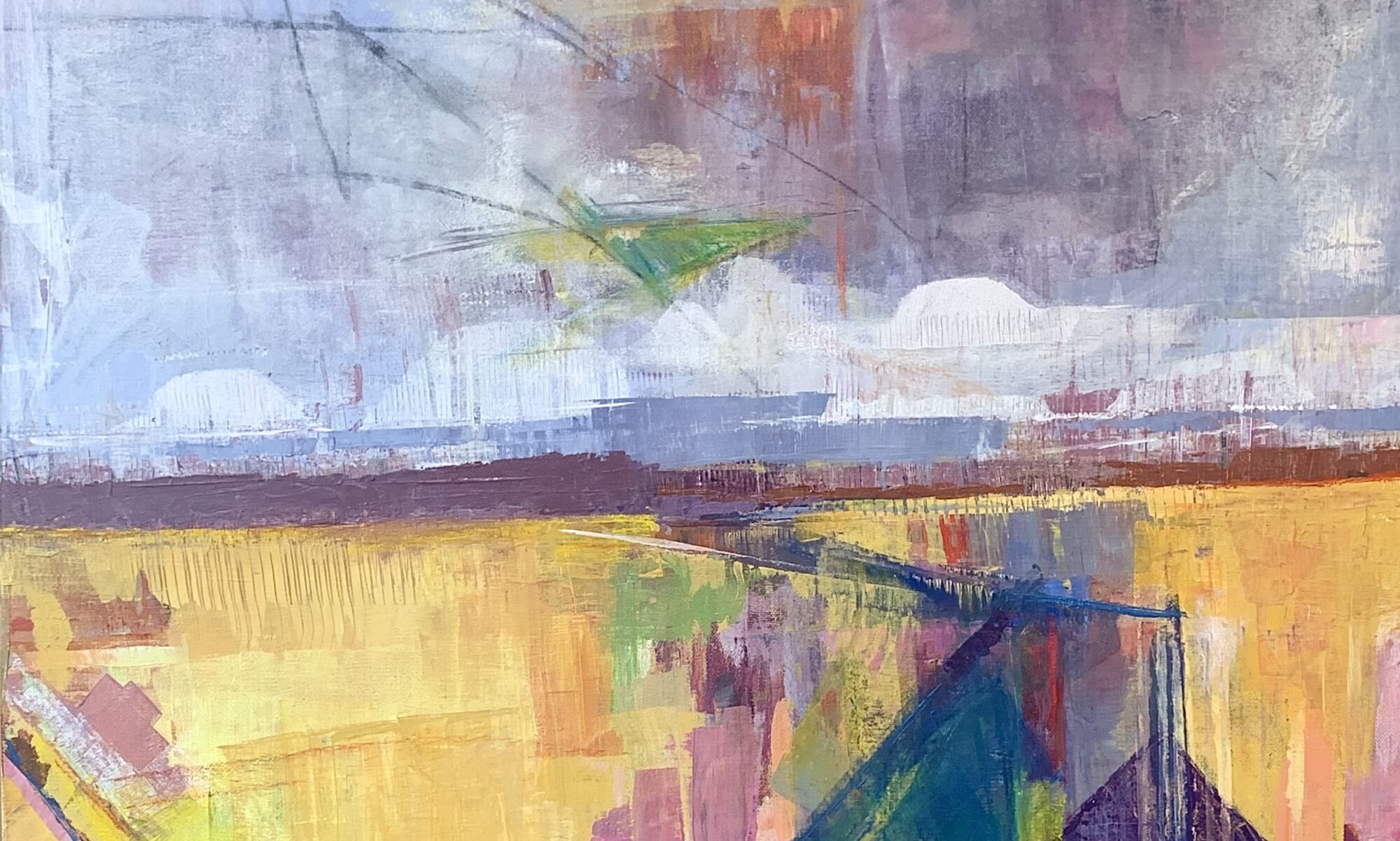
My recent work provides me with an entirely new outlet for my obsessions. I feel that I often treat my art not as a grand statement, or a refined image, but rather as a series of experiments. I am seduced by the endless possibilities of what can form on a two dimensional surface. This is what propels me forward. Therefore, I have little patience for laboring over large precious canvases and carving out detailed images. One thing that I constantly struggle with is the balance between abstraction and representation, as well as spontaneity and control. This new body of work, the “Chromascapes” deals with these issues in ways I previously have not.

My subject matter has always used the natural world as a primary source of inspiration, whether that be through abstract biological forms, landscapes, trees, or patterns. Nature remains the subject of the Chromascape Series, though less directly. While I have included my pastels under the the umbrella of the Chromascape Series, I handle them very differently. For right now, I am merely speaking of the acrylic paintings. The paintings all feel like landscapes to some extent. The primary reason for this is that almost all the paintings of this series have a horizontal line or break in them that creates the sense of the horizon. One question I must ask myself, and ask the viewer, is whether these would still be landscapes without it. Obviously, I embrace the use of landscape through my titling, “Chromascape” which represents the idea of a color landscape. These are works of color, with color being the primary subject and landscape a secondary one.

Nature is also addressed in the methodology of these works. Water, in a sense, does the painting. I pool large amount of water on the surface of the paintings. I use pouring methods, and minimal brushwork, to push paint through the water. Environmental factors in the room, on the surface of the table, and in the paint itself, control most of the major directions. I make minor adjustments, by dragging a pool of water in one direction, or angling the canvas. The ways the colors mix, bind, and dance around each other, however, remains mostly out of my control. I suppose I consider this a collaboration between myself and the water.

The process is difficult for me, it is a leap. Many contemporary artists have used similar art making processes, and I have often seen it to be a gimmick. Despite my reservations, I have come to this process naturally, after years of painting practice and I see it as the next logical direction for my work to take. Rather than try to make these into something they are not, I want to simply understand the process, method, and concept I am bringing to these works. They are color, water, movement, chance. They are what I believe the universe to be. I think it is important that they are landscapes, because the landscape ties them to our worldly experience, it brings them home to our day to day lives. The landscape is an image we can relate to and through it I hope we can appreciate the explosion of potential behind it.