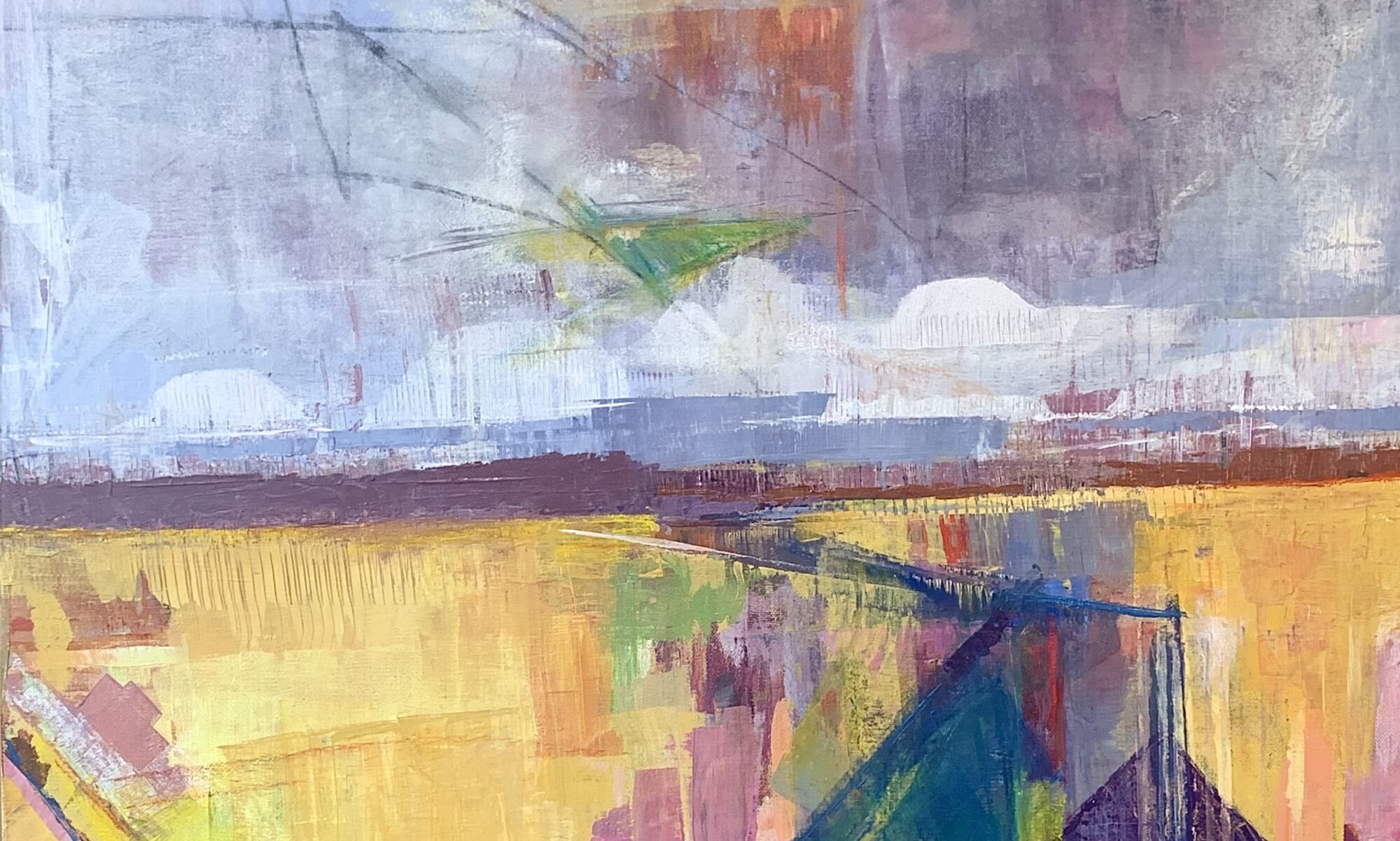
I remember well a MIAD instructor I once had telling me and the rest of the painting class never to waste paint. “Keep a stack of panels handy” she would say, because left over paint on the palette could always be something. Well here is my something. So, using generic interpretations of my landscape theme I have composed these mini studies on a gessoed piece of watercolor paper that I taped off. I am doing them in between panel paintings. Great things are happening actually. It is always an invigorating feeling when you let go and play, and it is good.
Pastel Drawing (sitting down)
I did this drawing today in the studio. I was taking a little break from painting I guess, while reflecting on a recent conversation about my work. The way I do pastel is different. I snuggle into my cozy chair and wrap myself around my drawing board. This is very different then standing at arms length from an easel. While different, I value both experiences and the results they produce.
A Painting Continues
I blogged about this piece a few weeks ago. To see days 1 and 2 click here.
These are days 3 and 4. The progress has been good, with today focusing on detail and subtle changes. The problem I think I face now is one of overworking. I feel it is starting to be be killed and I have to consider stopping. Something nags me about it and perhaps it is the simple truth that the little ones work better. I have mixed feeling about this piece and do not know yet if I will keep going or not.
New Painting
I began this piece a few days ago. These are two “in progress” shots. This image is based on photograph, as well as a few drawings I have done. I also have a smaller painting of the same image, which will provide an idea for where this is going. Chromascape 45 was completed a few months ago. It will be interesting to see how a similar composition will translate to a larger scale (the piece I am doing now is 20″ x 30″). I am aware in distinct differences in paint handling at this size. Also, of course, I am using a larger painting knife. The size however gives me the freedom to have a wider range of mark making. I could make more use of this freedom perhaps.
Waiting for varnish to dry…
I do not love framing, and now I know I do not love varnishing either. I have spent the last few days waiting for varnish to dry and have started planning my next painting. This is a drawing I did in my studio today during the down time. It is not to the scale yet of the next canvas, but none the less it is the beginning of a thought process. I will probably draw this composition out one or two more times before beginning to paint. The canvas I am preparing for this painting is 20″ x 30″.
Chromascape 55
6.5″ x 10″
oil on panel
$350.00 via PayPal
$10.00 shipping within US
Chromascape 54
20″ x 30″
oil on canvas
$470.00 via PayPal
$15.00 shipping within US
More Progress
Remember that painting I blogged about a week or so ago? If not, view it here.
The piece continues to evolve, and I continue to document the changes I am making. The palette has now shifted a bit. I think it is almost done now, I don’t expect to do any radical changes at this point. It is interesting to look back at where it has been. These two versions were done in the last three days, the bottom image is the most recent state of the work. I think things are falling into place.
Vancouver Art
I spent the last few days in Vancouver, B.C., where I manged to do a little gallery hopping. Vancouver has a very active art scene. I went to Gallery Row, in South Granville. This is a small, trendy area full of boutiques and galleries. Here I visited a number of noteworthy galleries, including the Petley Jones Gallery, Jacana Gallery, Kurbatoff Gallery, and the Elissa Cristall Gallery. A little off the main stretch was the the Diane Farris Gallery. Here I saw an exhibition called Waterways by artist Judith Currelly. Currelly’s muted paintings of animals and landscapes are slightly stylized and evoke a sense of history and native influence. (See image)
In downtown Vancouver I came across the Rendezvous Gallery. The gallery person I spoke to informed me that all the work in the gallery was North Western Coastal artists. The space was big, but still packed floor to ceiling with work, mostly bright and colorful landscape paintings. The gallery felt warm and vibrant and I think this may have been my favorite stop. Overall it was an exciting trip. Vancouver is a fascinating city full of diversity and culture.
Image: Judith Currelly, Inside Passage, Diane Farris Gallery, 2010
Progress
This is the painting I have started based on the drawing I did last week. I am referencing the colors of a photograph. I am doing the painting in stages. These images are from two different studio days. I anticipate one more studio session will complete the piece. I have kept the paint thin as to avoid too much surface build up. The palette hasn’t quite come together yet, so I am looking forward to getting back into it.
Planning? Me?
I started a new piece today. Usually I will just go for it, referencing a photo, maybe making a quick drawing. Today I made a preliminary drawing, to scale. I rarely plan so meticulously. However, I am going to attempt a larger painting. Most of the works I have done in oil recently have been small, because the direct alla prima painting I have been doing does not seem to work as well large. I tried a few, and they have been pretty unsuccessful. I just cannot accept that. So, now I try again with a game plan. I will post updates soon!
Chromascape 53
7″ x 9″
oil on panel
$350.00 via PayPal
$10.00 shipping within US
Writings on Art- Mark Rothko
I am currently reading “Writings on Art” by Mark Rothko. This is a collection of letters, notebook entries, and essays by a very influential artist. Rothko writes a lot about creativity and education. He writes about how educating children on art should focus on inspiring creativity rather then instituting a regiment of lessons and disciplines. This reminds me that much of art making is letting go of the inhibitions we develop as adults. This is the part of art making that cannot be taught but only encouraged. So many believe that if they learn to draw they can be an artist. However, there are so many more intangibles components.
Many of Rothko’s texts are fragmented. However, this adds to the romance of discussing art. It is reminiscent of anyone’s studio journal which makes it fun to muddle through.
Mark Rothko, Writings on Art, Yale University Press
Chromascape 52
7″ x 11″
pastel on paper
$95.00 via PayPal
$5.00 shipping within US
Chromascape 47
12” x 16”
oil on canvas board
$245.00 via PayPal
$10.00 shipping within US
Alla Prima
I have been focusing on an “alla prima” style of painting. This means that I do the painting all at once. This is not exactly an accurate interpretation of the original Italian meaning, but the idea has been adopted in Western practice all the same. Most of my recent work, using direct painting methods, was done in a single session. I used a book by artist Ricard Schmid to provide examples of this in the recent class I taught in Door County. Schmid’s book covers a range of direct painting styles and techniques. The writing that accompanies the work is helpful in understanding the thoughts behind the studio practice. My palette, of course, is much more saturated that Schmid’s quite transitions and tones. None the less, the book is an excellent find.
Alla Prima is published by Stone Prairie Press, 2008
Chromascape 46
7″ x 9″
oil on panel
Sold!
Small Spaces
I love the way these smaller pieces are going. I think the scale of the piece works well with the scale of the mark making. Also, I could not easy achieve these thick, creamy surfaces on a larger scale without using a different approach completely. There is an intimacy with the paint here. I think it is evident in the few larger works I have posted recently that this style does not translate well large. As I paint these, I experience a very physical connection to the medium. I push and pull at the paint, sculpting shapes, lines, and transitions through the edge of a painting knife. I very much look forward to showing this series.
Studio Rants
There was definitely some frustration in my studio today. Ever have one of those days where nothing turns out? Yeah, sometimes I think my head just is not in it. Sometimes I think I paint aimlessly and get lost because I don’t know what I want. I am working on figuring that part out. In any case, I worked on a few different pieces today, and this is one of them. Not done yet because I am not really happy with it. My abstract landscapes are evolving. I have yet to decide what is next. With these thick oil paintings, I can only do into them so many times before the surface is too think and textured. If I don’t get it in the first few shots, it is often a lost cause.
Weekend in Door Co
I had a nice three-day class in Door County. I taught “Painting Without a Brush” at the Peninsula School of Art in Fish Creek. The focus of the class was on direct painting methods with a painting knife. I feel I always learn as much as I teach while doing these workshops. Everyone did really wonderful work and it was a beautiful time to be up north.
This image was done from photograph, I was demoing using a painting knife to paint a landscape. I am happy with how this piece turned out, and it may influence the direction my current work will take.
Chromascape 43
9″ x 7″
oil on panel
$350.00 via PayPal
$10.00 shipping within US