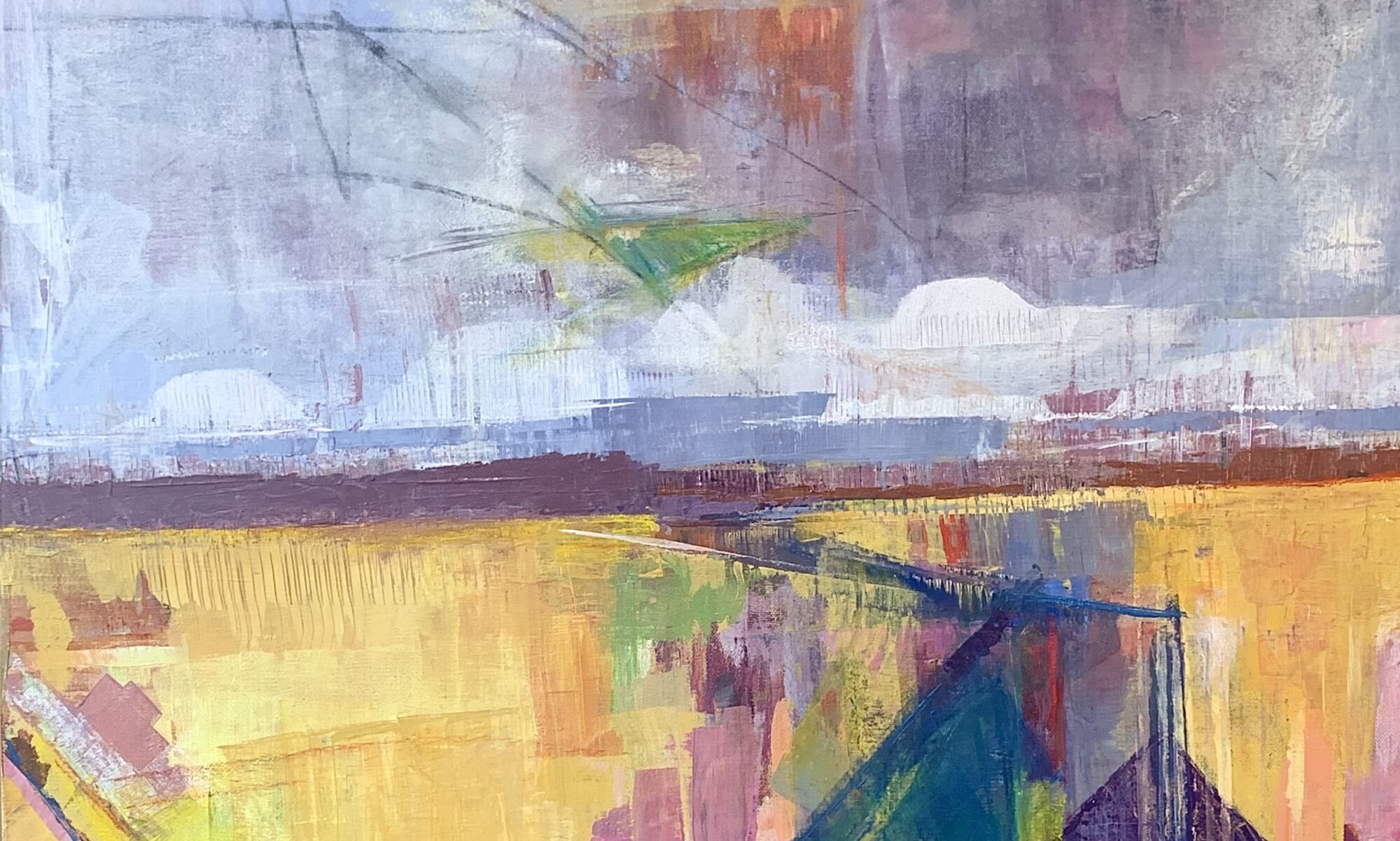
Driving down the road today on my way to work I was struck by the subtle color changes that have occurred in the Wisconsin landscape over the last month. Summer now in full swing, the landscape has filled in with vibrant greens. However, a rather dry few weeks is making many of the grassy areas in Mitchell Park turn yellow. The color relationships fascinate me. When I observe a panorama I am quickly struck by the horizontal color bands of earth and sky. Tree lines are often a dramatic transition on the horizon. These relationships are really what drive my work. I often paint the same scene more than once- manipulating, enhancing, and tweaking the colors each time. I have taken hundred of pictures, often from my car. These pictures inform most of my paintings.
Chromascape 99
chalk pastel on paper
6″ x 10″
$250.00 via PayPal
$5.00 shipping within US
Chromascape 98
chalk pastel on paper
6″ x 10″
$250.00 via PayPal
$5.00 shipping within US
Reception at Woodwalk
I was at the Woodwalk Gallery, in Egg Harbor Memorial Day weekend for the opening reception of the season. This is my first time being represented by this gallery. After teaching several classes at the Peninsula School of Art, I realized that Door County has a remarkable arts culture. So, in my search for galleries I came across the Woodwalk website. It was the other artists I saw represented that really made me choose to apply. It is important for any artist preparing to approach a gallery to know what they already show. There is usually a “feel” you get for the kind of work a gallery prefers by browsing the other artists they represent. You also want to make sure they don’t already represent someone too much like you.
I met with Margaret Lockwood at her gallery and was excited to be invited to show at the gallery. The reception was packed and I got to see a lot of wonderful people. The space is unique in that it is essentially a barn that has been converted in to a gallery. The gallery itself is very professional and the space lends itself well to the beautiful setting it is in.
Woodwalk Gallery and Events Center
is located at:
6746 County Road G, Egg Harbor 54209.
This is 7 miles north of Sturgeon Bay and
5 miles south of Egg Harbor ½ mile off Highway 42 on
County Road G (turn toward the Bay at Shartner’s Market).
Open daily 10-5 from May 1 through October.
Call: 920-868-2912
Frames
This is what the frame on most of my pieces looks like. In some cases I stain it, but many are left raw. There is a slight space around the image, which helps the viewer see the edge of the painting where the ground color is visible. These frames are made using basic miters. The wood is pine.
Another Plein Air Day
I am trying to get some plein air practice in before taking on the Cedarburg Plein Air Event and the Domes Plein Air Competition this summer. I am very aware of how differently I paint when painting plein air. Photographs conveniently help me to filter information and focus on color and composition in a way that realty does not. The overwhelming information I receive on-sight changes my focus and intention. I enjoy the stories created while doing it, and the challenges it presents. I also enjoy an excuse to be outside on a beautiful day to experience the environment and not see it as just a collection of shapes, colors, and lines. I didn’t get rained on today- so that was good, and I feel good about the painting.
This was at Greenfield Park.
Chromascape 95
chalk pastel on paper
10″ x 6″
$250.00 via PayPal
$5.00 shipping within US
Chromascape 91
10″ x 7″
oil on panel
Sold!
Chromascape 90
10″ x 7″
oil on panel
$320.00 via PayPal
$10.00 shipping within US
Chromascape 89
7″ x 10″
oil on panel
$350.00 via PayPal
$10.00 shipping within US
Chromascape 88
Plein Air Painting
So, truth be told- I haven’t done a lot of plein air painting. This summer it is my goal to do much more of it. I have found that painting outside from life is challenging for me because there is too much information. In an attempt to include everything I see the paintings often become sloppy and confused. A photograph filters out some of the noise. A photograph allows me to step away from reality a bit and focus on image, rather than life. However, I see this as an opportunity to grow. A few days ago I took my new portable easel out to the lagoon at Sheridan Park. The sun was shining, it was like 65 degrees. It was also my birthday so I needed a little adventure.
Cézanne’s Subjectivity
I am currently reading the book Proust was a Neuroscientist by Jonah Lehrer. The book is about great artists of all forms and how their art was ahead of our understanding neuroscience. For example, Lehrer describes how Walt Whitman’s writing connects “soul” to the physical body. Lehrer describes the culinary art of Auguste Escoffier and the discovery of umami (the 5th taste after bitter, salty, sweet, and sour). Also covered in this book is Paul Cézanne. I just had to write about this chapter. As Lehrer writes, “Cézanne’s art exposes the process of seeing” (98). Cézanne, as a post impressionist, took us away from the idea that seeing was all about light. Rather, Cézanne showed us that seeing was about imagination, Everything we see with our eyes is processed by our brains. As our brains are skilled at drawing connections and making inferences, this process greatly affects what we think we see. Seeing is creating. Cézanne’s paintings attempted to expose this higher reality. “Cézanne abstracted on nature because he realized that everything we see is an abstraction” (109).
Lehrers’ book is an interesting read and I recommend it for those interested in how art and science work together in understanding the world.
Image: Paul Cézanne, Mont Sainte-Victoire, 1882-1885
My Studio
Here is an inside shot of my studio, cleaned up for last Friday’s Gallery Night. A lot of recent work is on the wall, half of which is going up to Woodwalk in Door County this weekend. That will leave me some room to make more paintings!
Chromascape 86
7″ x 10″
oil on panel
available for purchase through the Woodwalk Gallery in Egg Harbor
Chromascape 84
Adventures in Framing
I have been working on different framing techniques for my Chromascape series. Some variations include adding a space and not varnishing. These are two samples. Both leave a space, but one is raw and one is varnished. It’s hard to decide which way to go, as I feel they need to all be the same but the different colors compliment different paintings. Another option I am considering is not framing at all but cleaning up and painting the sides of the panels. In doing this I use the color of the under painting, which accentuates the under painting. I am not sure where I will go from here, but I have to make decision soon as I have a few shows coming up!
Chromascape 83
9″ x 7″
oil on panel
$315.00 via PayPal
$10.00 shipping within US
Chromascape 80
7″ x 11″
chalk pastel on paper
Sold!
Chromascape 79
16″ x 40″
oil on canvas
Sold!
Steven Pinker on art and beauty
I just finished reading Steven Pinker’s The Blank Slate, which is broadly about the fact that we are not blanks slates, that genetics plays a large role in who we are as humans. I was pleasantly surprised to find out that Pinker was concluding his book with a discussion about the arts. He quotes the late Denis Dutton (a favorite philosopher of mine) many times. Pinker describes how an appreciation of beauty is natural to our species for evolutionary and biological reasons. He points out that modernism and post modernism removed us from this natural approach to art and left us essentially with no where to go. Popular culture similarly makes beauty less precious and more accessible to the common man, which forces artists to reject beauty. “It is hard to distinguish oneself as a good artist or a discerning connoisseur if people are up to their ears in the stuff…..Now any schmo could have beautiful things.” All of this makes artists reject the most natural inclinations we have to art in an effort to stand out as something rare. Pinker draws this back to some of our most natural behaviors- status seeking. Despite what you think about evolutionary psychology, this chapter is a great read.
Steven Pinker, The Blank Slate (Chapter 20), Penguin Books, 2002